
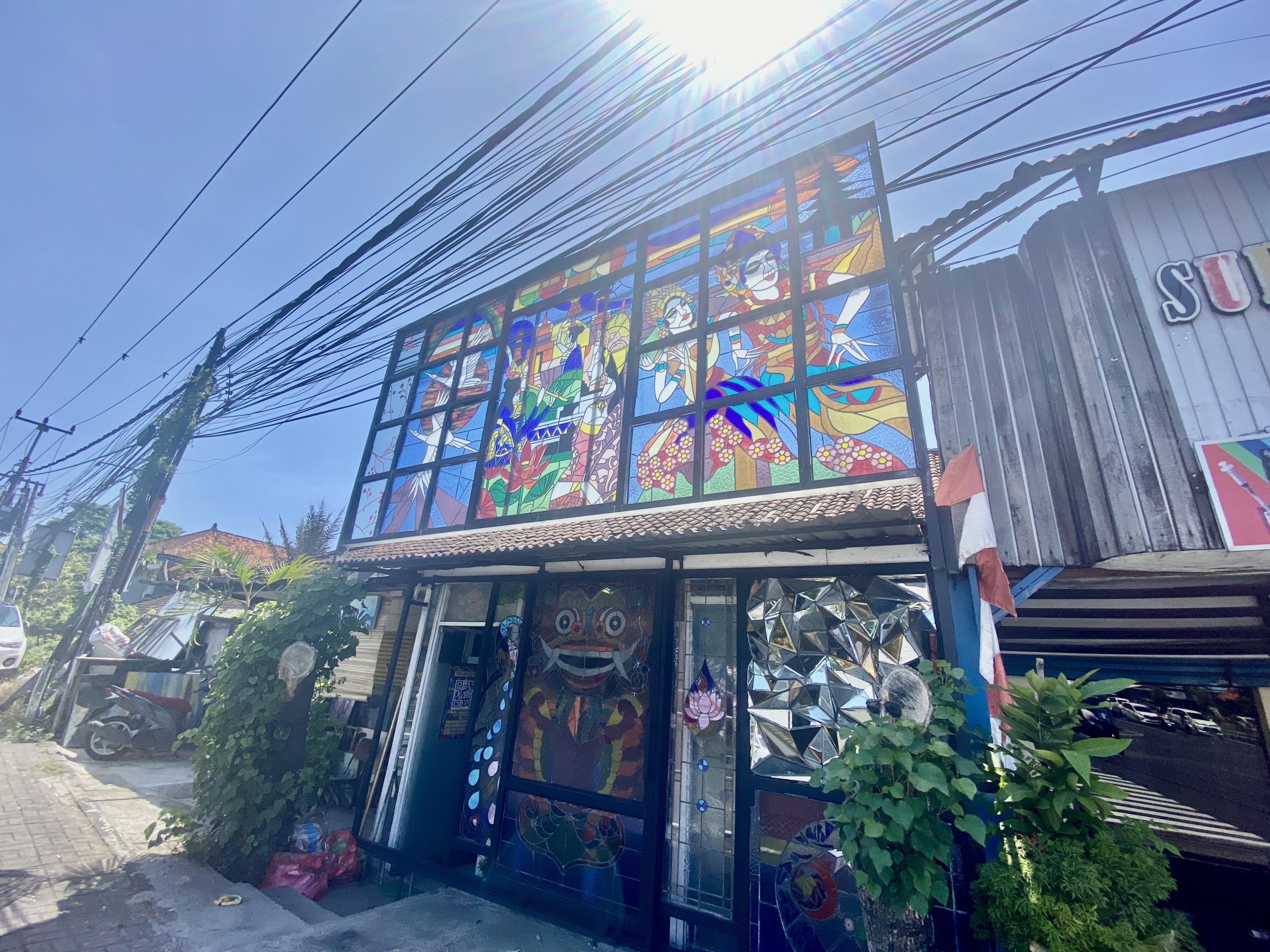
You will probably find us by the light. On a clear Bali morning the sun hits the big window above our door and the whole facade turns into colour — cobalt, ruby, marigold, jade — dancers spilling across the glass above the street. Below, a Barong mosaic guards the doorway with his glass teeth. That window is not a sign we bought. It is a sample. Everything you see on the front of the building was cut, ground, foiled, soldered and set by the same hands that will make your panel.
A workshop, not a showroom
We started in 1990, when very few people in Bali were working with leaded glass. Back then most of our work went into hotels and temples around Denpasar and Sanur. More than three decades later the craft has not changed much: a paper pattern, a glass cutter, a grinding wheel, copper foil or lead came, and a long afternoon at the bench.
Because of that, a visit here is not a polished retail experience. You will step over offcuts. You will hear the grinder. If you come in the morning you will usually catch someone laying out a panel on the light table, and you are welcome to lean over and watch.
Glass only looks like decoration until you see someone cut it. Then it looks like a decision.
What we make
- Windows and skylights — leaded panels for villas, hotels and restaurants across Bali, built to the opening you measure.
- Doors and partitions — tempered-backed stained glass door inserts and room dividers that survive tropical humidity.
- Balinese motifs — Barong, legong dancers, lotus, frangipani, wayang figures, drawn in-house rather than traced from a catalogue.
- Lamps and mirrors — copper-foil shades, mosaic mirrors, small pieces that fit in hand luggage.
- Repairs and restoration — releading old panels, replacing cracked glass, re-soldering joints that have gone soft with age.
How a panel is made
Every commission moves through the same six benches, and on a visit you can usually see two or three of them running at once.
1. Drawing
A full-size cartoon is drawn on paper, at exactly the dimensions of your opening. Line weight here decides how heavy the finished panel will read from across a room.
2. Choosing glass
We pull sheets from the rack and hold them against the window — opalescent, cathedral, seedy, rippled. This is the part visitors enjoy most, and the part photographs never capture.
3. Cutting and grinding
Each piece is scored, broken and ground until it sits inside its line with a hair of space for the foil.
4. Foiling or leading
Small, detailed work gets copper foil. Large architectural panels get lead came, which carries its own weight over a wide span.
5. Soldering
Both faces are soldered, then the seams are cleaned and patinated black, copper or silver depending on the room the panel is going into.
6. Cement, polish, crate
Leaded panels are cemented for weatherproofing and rigidity, polished, and crated for shipping. We ship worldwide and have sent work to Australia, Japan, Europe and the United States.
Planning your visit
Sanur is an easy trip from Denpasar, Kuta, Seminyak or Ubud, and we are a short ride from Sanur beach and the Sindhu market area. Mornings are best: the light through the front window peaks around 10am, and the benches are all in use before the afternoon heat.
If you are bringing measurements for a commission, bring the opening size, the direction the window faces, and a photo of the room. Fifteen minutes at the light table with those three things usually settles the design.
Groups, students and photographers are welcome — just message ahead so someone is free to talk you through the benches rather than shouting over a grinder.